
Secure messaging with ESUNT is designed to give users independent control over an additional layer of encryption protecting their private conversations. Whether communicating through the complete Standalone ESUNT application or a compatible third-party messaging platform, the objective is to protect message content before it reaches the underlying communication service.
ESUNT combines familiar messaging workflows with user-controlled over-encryption, allowing trusted participants to exchange protected messages using independently established secure connections.
Starting a Secure Conversation
Before exchanging over-encrypted messages, both participants need an established ESUNT secure connection.
The intended messaging workflow involves a few straightforward steps:
- Select a trusted contact with an established ESUNT secure connection.
- Verify the protection status using the available security indicators.
- Compose your message through the supported messaging interface.
- Send the protected message using the selected communication channel.
- Receive and read replies using the corresponding ESUNT secure connection.
The exact interface and sequence of operations will depend on the final application implementation.
How ESUNT Protects Messages
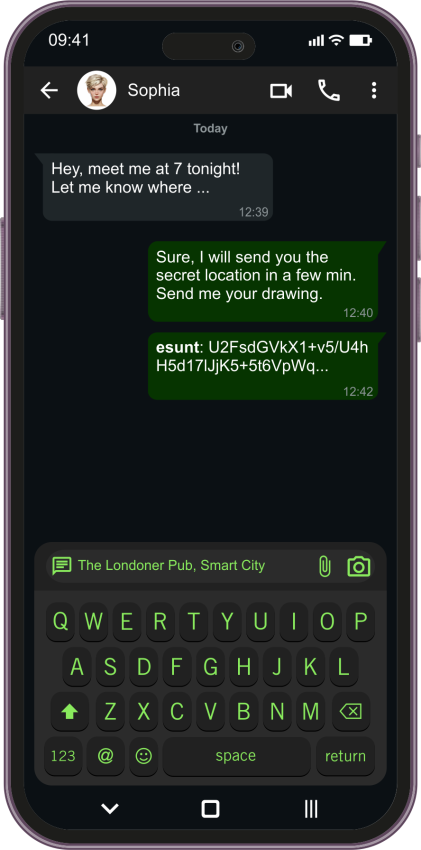
ESUNT is designed to apply an independent encryption layer before message transmission, using cryptographic material associated with the established secure connection.
When integrated with a compatible communication platform, the protected content would be passed to that platform for delivery. The platform's own encryption and transport mechanisms would continue to operate independently.
At the receiving end, ESUNT would use the corresponding secure connection information to recover the protected message content.
This approach is intended to provide additional protection beyond the encryption offered by the underlying messaging service.
Recognizing Protected Messages
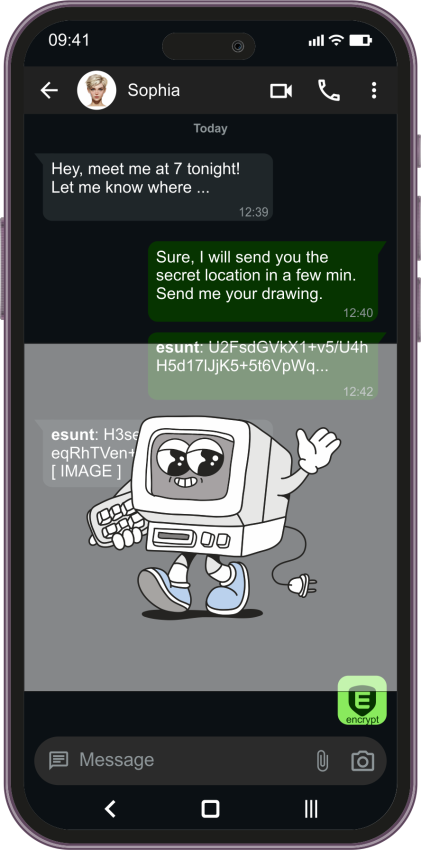
The envisioned ESUNT interface includes a padlock indicator to help users recognize when independent encryption protection is active.
Before sending sensitive information, users should verify that the intended secure connection is selected and the appropriate protection status is displayed.
A security indicator represents the application's reported protection state. It does not independently verify a contact's identity or guarantee that the entire device and communication environment are secure.
Managing Conversations
The complete ESUNT application is envisioned to support familiar conversation management while maintaining independent cryptographic relationships with trusted contacts.
Users would be able to organize conversations, continue exchanges with established contacts, and manage the secure connections associated with different communication relationships.
Separate cryptographic contexts could be maintained for personal, professional, or other communication purposes, providing flexibility in how protected relationships are organized.
Secure Messaging with Existing Applications
One of ESUNT's principal objectives is to let users benefit from over-encrypted messaging without abandoning their preferred communication platforms.
Where technically supported, ESUNT could protect message content independently while the existing application continues to handle message delivery and its normal communication functions.
Integration possibilities and limitations are discussed in the ESUNT Technology Book.
Messaging Privacy and Security Considerations
Independent message encryption is an additional security measure, not a complete solution to every privacy risk.
Users should remain aware that:
- Contact verification matters. Encryption alone does not establish the real-world identity of a communication partner.
- Device security remains essential. Compromised devices may expose information before encryption or after decryption.
- Communication metadata may remain visible. Over-encryption does not necessarily conceal participants, timing, or other information handled by the underlying service.
- Message deletion has limitations. Recipients, screenshots, backups, and external storage may retain previously exchanged information.
The practical protection offered by ESUNT will depend on its implemented security architecture, supported integrations, and independent evaluation.
Beyond Individual Messages
The complete ESUNT application is also envisioned to support protected group communication, file exchange, and additional communication features.
These capabilities are covered separately in the Calls, Files, and Groups chapter.