
Managing security in ESUNT gives users control over the independent encryption layer protecting their communications. The complete ESUNT application is designed to provide practical tools for managing cryptographic key-pools, secure connections, key rotation, and protection settings.
These controls are intended to help users maintain separate security relationships for different contacts and groups while keeping the underlying cryptographic processes manageable.
Understanding ESUNT Security Controls
ESUNT is designed around user-controlled over-encryption, operating independently of the security mechanisms provided by communication applications.
The envisioned security management interface would allow users to:
- Review secure connections associated with contacts and groups.
- Manage cryptographic key-pools used for independent encryption.
- Control key rotation and supported security operations.
- Monitor protection status through interface indicators.
- Manage or remove security relationships that are no longer needed.
Managing Cryptographic Key-Pools
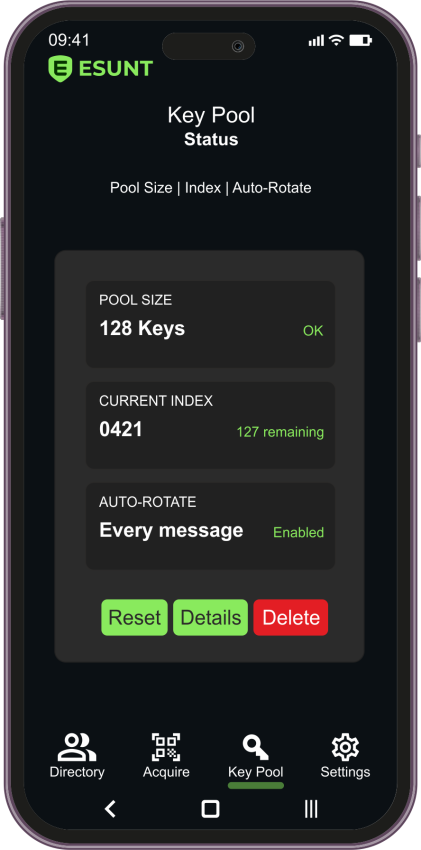
A fundamental feature of ESUNT is its proposed use of deterministically generated cryptographic key-pools to support protected communication between participating users.
These key-pools provide cryptographic material for the independent encryption layer. Their generation and use are governed by the ESUNT architecture and the information established during secure connection setup.
In everyday use, the application is intended to handle the necessary cryptographic operations without requiring users to understand or manually manipulate individual encryption keys.
Using Multiple Key-Pools
ESUNT is designed to support multiple independently managed key-pools, allowing different cryptographic contexts to be maintained for separate communication relationships.
For example, users could organize their security relationships around:
- Personal contacts - Private communication with family members or friends.
- Professional contacts - Protected exchanges with colleagues and business partners.
- Trusted groups - Separately managed protection for selected communication groups.
- Different communication purposes - Additional security contexts where appropriate.
This separation is intended to provide greater flexibility and reduce unnecessary dependence between otherwise unrelated communication relationships.
Understanding Key Rotation
Key rotation is an important part of the proposed ESUNT cryptographic architecture. It involves changing the cryptographic material used for protected communications according to the established security process.
ESUNT's deterministic key-pool approach is designed to support the selection and rotation of encryption keys within a secure communication relationship.
The application is intended to manage these operations while maintaining the necessary correspondence between participating users.
The final implementation will determine which operations are automatic and which security controls are available directly to users.
Checking Encryption and Protection Status
The envisioned ESUNT interface includes a padlock indicator to help users recognize when independent encryption protection is active.
Before sharing sensitive information, users should:
- Confirm that the intended contact or group is selected.
- Check that the appropriate ESUNT secure connection is available.
- Verify the displayed protection status.
- Use the supported protected communication workflow.
A visible protection indicator reflects the application's reported encryption state. It does not independently prove the identity of a communication partner or guarantee the security of the entire device.
Updating and Re-Establishing Secure Connections
Communication relationships may need to be updated when users change devices, replace security information, or reorganize their trusted contacts.
The complete ESUNT application is envisioned to provide procedures for updating or re-establishing secure connections while helping users identify which cryptographic relationship is currently in use.
If participants no longer have compatible security information, protected communication may require a new connection setup before it can continue.
Protecting Security Information
Independent encryption depends on responsible management of the cryptographic information used by participating devices.
Users should follow several essential practices:
- Protect device access using appropriate authentication and security settings.
- Verify trusted contacts before establishing or replacing secure connections.
- Avoid exposing sensitive cryptographic material through screenshots, messages, or insecure storage.
- Review security relationships when contacts, devices, or communication requirements change.
- Understand recovery limitations before removing information required for future decryption.
Security Management and Data Privacy
Managing encryption keys and secure connections is closely related to controlling locally stored information and communication history.
ESUNT's envisioned data management features include soft deletion and hard deletion, with different implications for recovering information and maintaining access to protected content.
Deleting cryptographic material may prevent future decryption using that material, but it does not guarantee removal of previously decrypted information, recipient copies, or external backups.
These subjects are explored further in the Data and Privacy Management chapter.
Maintaining Independent Communication Security
ESUNT aims to make independent encryption management accessible without requiring users to perform complex cryptographic operations manually.
By combining separately managed key-pools, key rotation, secure connection controls, and visible protection indicators, the complete application is intended to give users greater control over how their communications are protected.