
Data and privacy management in ESUNT is designed to give users greater control over their protected communications, locally stored information, and cryptographic material. The complete ESUNT application is envisioned to provide practical tools for managing communication privacy, data deletion, and access to encrypted content.
ESUNT's independent over-encryption approach aims to reduce dependence on communication providers for content confidentiality. However, effective privacy also requires responsible management of information stored on devices, shared with contacts, or retained by other applications.
Understanding Your Communication Data
When using a secure communication application, several types of information may be involved:
- Message content - Text and other information exchanged between participants.
- Files and attachments - Documents, images, and other shared content.
- Contact and connection information - Details associated with trusted communication relationships.
- Cryptographic material - Information required to encrypt or decrypt protected communications.
- Communication metadata - Information such as participants, timestamps, and transmission details.
ESUNT is intended to provide independent cryptographic protection for supported content. It does not necessarily conceal communication metadata or information processed outside its protection mechanisms.
Managing Locally Stored Information
The envisioned ESUNT application would allow users to manage information associated with their conversations, contacts, and secure connections.
Depending on the implemented features, users could review stored information, remove unwanted content, and manage the cryptographic material associated with protected communication relationships.
Local data management is particularly important when changing devices, ending a trusted relationship, or preparing to stop using the application.
Soft Deletion
Soft deletion is envisioned as a way to remove selected information from normal use without necessarily eliminating every possibility of recovery.
Depending on the final implementation, this could allow users to remove conversations or other application information from their active workspace while retaining information needed for supported recovery operations.
Soft deletion should not be considered permanent destruction of information. Data may remain accessible through retained cryptographic material, application storage, or backups.
Hard Deletion
Hard deletion represents a more restrictive approach to controlling access to protected information.
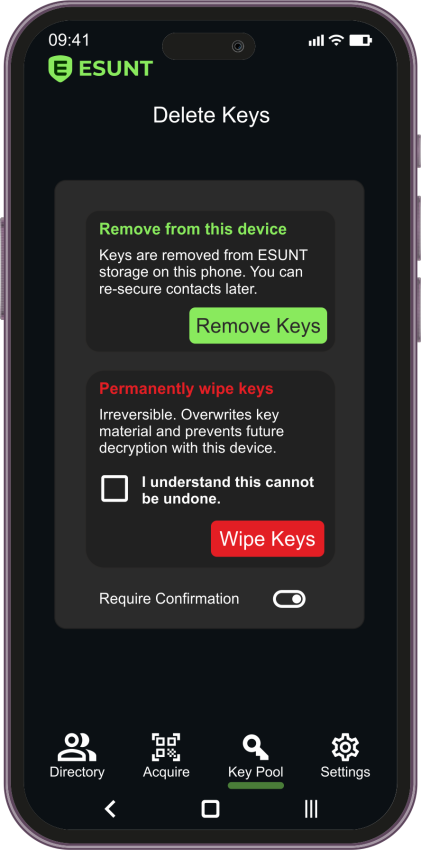
ESUNT's proposed architecture includes the ability to remove cryptographic material required for decrypting selected protected content. Where no usable copies of that material remain, future decryption of the affected ciphertext may become impractical.
Before performing a hard deletion operation, users should understand its potential consequences:
- Loss of access - Protected information may become permanently inaccessible if the required cryptographic material cannot be recovered.
- Limited recovery - Restoring ordinary application data may not restore the keys required for decryption.
- Existing copies - Previously decrypted information may remain available elsewhere.
- Other participants - Deletion on one device does not automatically remove information held by other users.
Hard deletion does not guarantee the physical erasure of all information from device storage, backups, recipient devices, or external systems.
Managing Backups and Recovery
Backups can help users recover information after device loss or replacement, but they also introduce additional privacy and security considerations.
For encrypted communication systems, recovery may depend on the availability of both the protected information and the corresponding cryptographic material.
Users should be aware that:
- Backups may retain copies of messages, files, or application information.
- Copies of cryptographic material may affect the consequences of deletion.
- Restoring encrypted content without the necessary decryption material may not restore access to its original contents.
- Third-party backup services may have their own storage, retention, and security policies.
The final ESUNT application will determine which backup and recovery operations are supported and how they interact with deletion controls.
Privacy When Using Other Applications
When ESUNT is used with a compatible third-party communication platform, its independent encryption layer is intended to protect selected content before that content reaches the underlying application.
However, the communication provider may still process or retain information outside ESUNT's protection scope, including account details, communication metadata, and other application activity.
Users should distinguish between ESUNT-protected content and information handled directly by the underlying communication service.
Additional privacy risks may arise when decrypted content is copied, exported, captured in screenshots, or shared through unprotected channels.
Protecting Your Privacy
Effective communication privacy involves both cryptographic protection and responsible user practices.
Recommended precautions include:
- Secure your device with appropriate authentication and operating system protections.
- Verify trusted contacts before exchanging sensitive information.
- Check ESUNT protection status before transmitting confidential content.
- Manage stored information and remove material that is no longer required.
- Review backup arrangements before deleting cryptographic material.
- Understand deletion limitations before relying on soft or hard deletion.
Maintaining Control Over Your Information
ESUNT's long-term objective is to combine independent encryption, user-controlled security relationships, and practical privacy management within a unified communication experience.
By providing tools for managing protected information, cryptographic material, and deletion operations, the complete ESUNT application aims to help users make more informed decisions about their digital privacy.