
Discover how ESUNT (End-To-End Secure User Network Technology) could be used in everyday situations, from protecting personal conversations to exchanging confidential business information. These practical examples and frequently asked questions illustrate the intended capabilities of the complete ESUNT application and its independent over-encryption technology.
The examples describe envisioned user workflows rather than procedures available in a released product.
Practical Examples of Using ESUNT
Example 1: A Private Conversation with a Friend
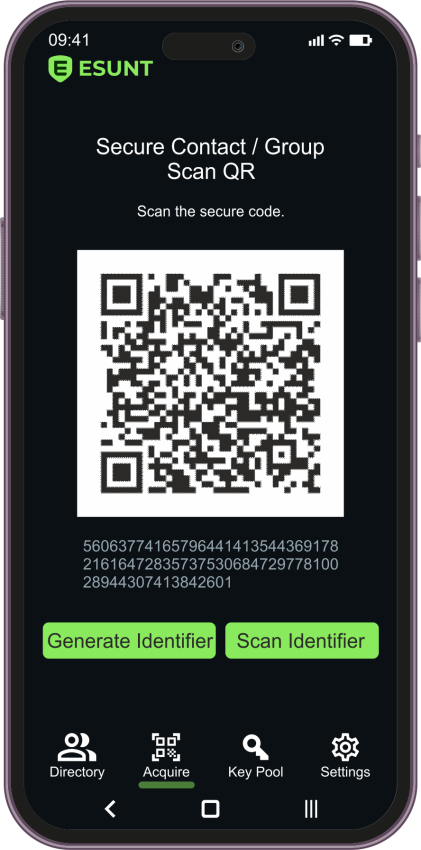
Two friends want to exchange personal messages with an additional layer of protection beyond their ordinary messaging application.
- Both participants prepare their ESUNT applications.
- They establish a secure connection using a supported method, such as QR code pairing.
- Each participant verifies the other's identity through a trusted method.
- They select the established secure connection and activate ESUNT protection.
- They exchange independently over-encrypted messages through a supported communication channel.
ESUNT aims to protect the message content independently of the communication provider's own security mechanisms.
Example 2: Confidential Business Communication
Two business partners need to discuss a confidential agreement while continuing to use their preferred communication platform.
- Both partners establish an ESUNT secure connection.
- They select a compatible communication application.
- The sender activates ESUNT protection before composing and transmitting sensitive information.
- The receiving partner uses the corresponding ESUNT connection to recover the protected content.
This scenario illustrates how ESUNT over-encryption for business communication could complement existing platforms without requiring a completely separate messaging service.
Example 3: A Private Family or Project Group

A family or professional team wants to organize protected conversations among selected members.
- A group is established using the supported ESUNT interface.
- The necessary secure communication relationships are configured for participating members.
- Members exchange messages through the supported group communication functions.
- Group security information is managed as participants are added or removed.
The envisioned group security controls would help maintain separate cryptographic contexts for different communication groups. Appropriate management of changing membership would be essential.
Example 4: Exchanging a Confidential Document
A professional needs to send a sensitive document to a trusted recipient.
- The sender selects the document and the intended recipient.
- ESUNT applies independent encryption using their established secure relationship.
- The protected file is transmitted through a supported communication channel.
- The recipient uses the corresponding ESUNT connection to access the original document.
This workflow could provide additional confidentiality for file exchange, although protection after decryption would still depend on recipient behavior and device security.
Example 5: Ending a Secure Communication Relationship
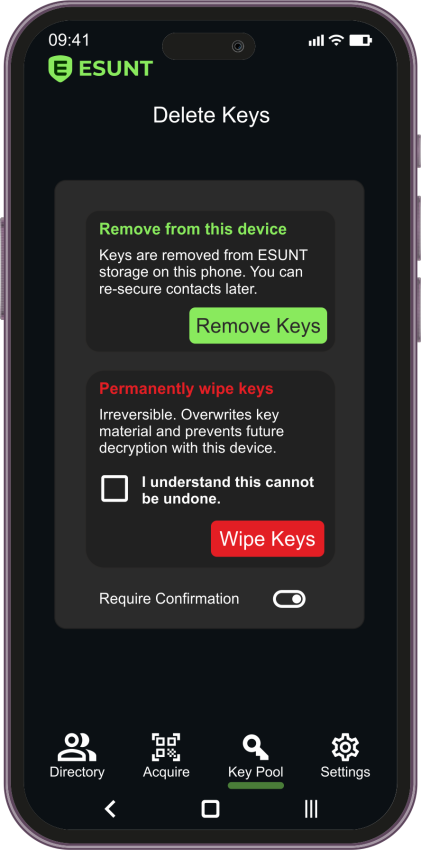
A user no longer needs a particular secure connection and wishes to manage the associated cryptographic material.
- The user identifies the relevant secure connection.
- They review any information or communication history they may need to retain.
- They select an available connection removal or deletion operation.
- They confirm the operation after reviewing its consequences.
Removing cryptographic material may prevent future access to affected encrypted content. However, hard deletion does not guarantee the erasure of information previously decrypted, copied, or stored elsewhere.
Frequently Asked Questions About ESUNT
What is ESUNT over-encryption?
Over-encryption means applying an additional, independently controlled encryption layer to information before it is transmitted through a communication service. ESUNT is designed to make this protection separate from the security mechanisms of the underlying application.
Is ESUNT a standalone messenger or an addition to existing applications?
Both. The complete ESUNT concept includes a standalone secure communication application and an independent encryption layer intended for integration with compatible third-party applications.
Do both participants need ESUNT?
Both participants need access to compatible ESUNT functionality and the corresponding secure connection information to exchange and recover ESUNT-protected content. An ordinary messaging application alone cannot decrypt that additional protection layer.
Will ESUNT work with every messaging application?
Not necessarily. Compatibility depends on the technical characteristics, restrictions, and available integration methods of each application and operating system. Support for individual platforms will require implementation and testing.
How do I know I am communicating with the correct person?
ESUNT's proposed connection procedures include exchanging security information through supported methods, such as QR codes or short-range connections. Users should also verify their communication partner's identity through an appropriate trusted method.
A padlock indicator can report the application's protection status, but it does not independently establish a person's identity.
Does ESUNT hide who I communicate with?
Not necessarily. ESUNT is primarily designed to add independent protection to supported communication content. The underlying platform may still process metadata such as account identities, communication participants, and transmission times.
What happens if I delete my encryption keys?
Removing cryptographic material may make affected encrypted information inaccessible if no other usable copies of the required material exist. It does not automatically delete previously decrypted content or copies retained by recipients and backups.
Learn more in Data and Privacy Management.
Can I maintain different secure connections for different purposes?
Yes, the proposed ESUNT architecture supports multiple independently managed cryptographic key-pools. These could be associated with separate contacts, groups, or communication purposes, according to the implemented application controls.
Is ESUNT already available for download?
ESUNT remains under development. The current development priority is its first Android minimum viable product (MVP), while this guide describes the envisioned complete application and its broader functionality.
Explore More About ESUNT
For additional information about the intended user experience, explore the other chapters of the How to Use ESUNT Book.
For architectural explanations and the underlying technical concepts, visit the ESUNT Technology Book.