
The complete ESUNT secure communication application is envisioned to extend independent over-encryption beyond individual text messages, supporting protected voice calls, secure file exchange, and private group communication.
These capabilities are intended to help individuals, families, professionals, and organizations communicate and share information while maintaining independent control over an additional layer of cryptographic protection.
Secure Voice Calls
Voice communication is an important part of the envisioned ESUNT application. The objective is to enable protected voice conversations between trusted contacts using independently established security relationships.
In the complete application, the intended calling workflow would include:
- Selecting a trusted contact with an established secure connection.
- Initiating a voice call through the supported communication interface.
- Checking the protection status using the available security indicators.
- Communicating securely through the implemented voice protection mechanism.
- Ending the call using the application's normal call controls.
Applying ESUNT protection to real-time voice communication will require appropriate implementation, performance testing, and security evaluation.
Protected File Exchange
ESUNT is also envisioned to support the secure exchange of documents, images, and other digital files between trusted participants.
The proposed workflow would allow users to select a file, choose a trusted recipient, and apply independent cryptographic protection before transmission through a supported communication channel.
Potential applications include:
- Personal documents - Sharing private records and sensitive information.
- Business files - Exchanging confidential proposals, reports, and commercial documents.
- Images and media - Sharing personal or professional content with trusted contacts.
- Professional collaboration - Transferring information between colleagues and business partners.
The security of file exchange would depend on the implemented encryption process, secure connection management, and handling of files before encryption and after decryption.
Private Group Communication
The ESUNT architecture is designed to support separate cryptographic contexts for different communication relationships, including trusted groups.
In the envisioned application, users would be able to organize private communication groups for family members, friends, colleagues, or other selected participants.
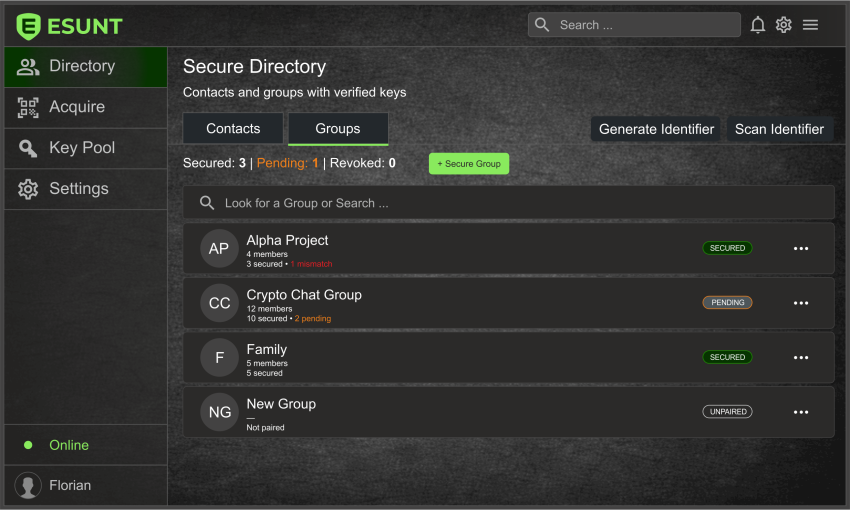
Potential group features include:
- Creating groups - Organizing selected contacts around a shared communication purpose.
- Managing participants - Adding or removing members according to the available group controls.
- Group messaging - Exchanging protected messages among authorized participants.
- Group file sharing - Distributing protected documents and other supported content.
- Independent group security - Maintaining cryptographic material associated with specific group relationships.
Group encryption requires careful management of participant access and cryptographic material, particularly when group membership changes.
Managing Group Security
Different groups may have different privacy requirements. ESUNT's proposed use of multiple independently managed key-pools is intended to support separation between communication relationships.
For example, users could maintain distinct security contexts for personal communication, family groups, and professional collaboration.
Removing a participant from a group would require appropriate security procedures to protect future communications. It would not automatically erase information previously received or stored by that participant.
Using ESUNT with Existing Communication Platforms
ESUNT's broader vision includes applying its independent over-encryption technology to compatible third-party communication applications.
Depending on the integration capabilities of each platform, this could potentially extend to supported messaging, file exchange, and other communication functions.
Not every application or communication feature will necessarily support ESUNT integration. Real-time calls, file transfers, and group operations may impose different technical requirements and restrictions.
Security and Privacy Considerations
Independent encryption can provide an additional layer of content protection, but it does not eliminate all communication security risks.
Users should understand that:
- Device security matters. Compromised devices may expose communications before encryption or after decryption.
- Recipient verification is essential. Protected communication depends on establishing connections with the intended participants.
- Group membership requires attention. Changes to participants may require updates to the associated security material.
- Stored information may remain accessible. Encryption and deletion controls cannot guarantee removal of previously received content, screenshots, or external backups.
- Communication metadata may remain visible. ESUNT over-encryption does not necessarily conceal call participants, message timing, or other metadata handled by the underlying service.
Expanding Secure Communication
By combining protected messaging with planned voice, file-sharing, and group capabilities, ESUNT aims to provide a flexible user-controlled secure communication environment for everyday and professional use.
These functions form part of the envisioned complete application. Their final availability, interoperability, performance, and security properties will depend on implementation and validation.